| Bell
Engraving |
S/N* |
Year** |
Description |
|
<<>>
Circa 1880 established at Berlin
<<>>
|
|
<<>>
Before 1888 moved from Berlin to Bad
Friedrichroda <<>>
|
|
<<>>Circa
1888 workshop established at Weimar
<<>>
|
| C F Schmidt Weimar vor dem Berlin. |
|
|
Label dated
to 1888-1896 . Originally purchased
in Germany and imported directly to
Chicago. |
|
<<>>Circa
1899 Weimar workshop merged with
Berlin<<>>
|
|
<<>>Before
1912 moved from Weimar to Berlin
<<>>
|
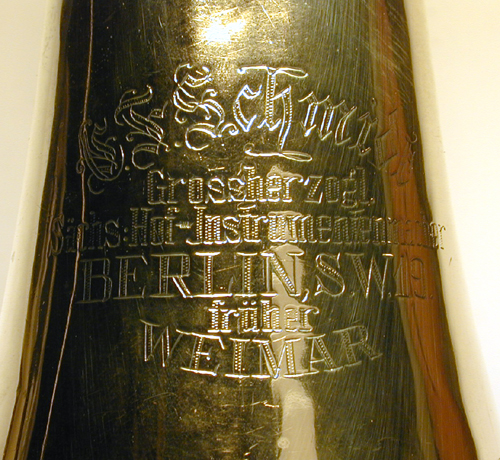
| C.F.
Schmidt/Grossherzogl. Sächs:
Hof-Instrumentenmacher/Berlin S.W.
19/früher/ Weimar |
|
|
Single B-Flat Horn with added
extensions used by Reginald
Morley-Pegge. Formerly in the Louis
Denaro collection.
|
|
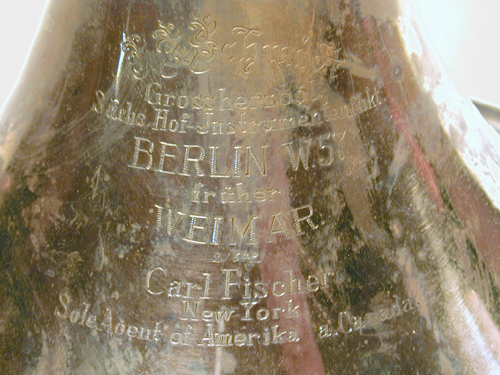
C.F. Schmidt
Grosshersogl.
Sächs:
Hof-Instrumentenmacher
BERLIN,
S.W.19.
früher
WEIMAR
Carl Fischer
New-York
Sole Agent Amerika
u. Canada.
|
|
|
Single F with
original F, E, Eb and D tuning slide
crooks. Kölner design with long
leadpipe into the valves, then the
tuning slide. No serial number.
Jonathan Ring Collection
|
| C.F. Schmidt/Grossherzogl. Sächs:
Hof-Instrumentenmacher/Berlin S.W.
19/früher/ Weimar/Carl Fischer/New-York.
Sole Agent Amerika/u. Canada |
|
ca. 1911? |
Very unusual to have Fischer label with
no S/N. Found in a band room in northern
Minnesota; Restored in 1979 by Marvin
McCoy who estimated date to be ca. 1911. |
| C.F.
Schmidt/Grossherzogl/Sachs:
Hof-Instrumentenmacher/Berlin, S.W.
19./früher/Weimar/12328/Carl Fischer/New
York Sole Agent Amerika/u. Canada |
12328 |
|
Full Double, lowest
Fischer S/N found to date. Owned by Richard
DeRosear. A very
unusual feature of the horn is that
the tubing from the main tuning
slide is wrapped across the body of
the piston thumb valve such that the
connections in and out of the valve
are reversed. This same tubing
wrap is found on another horn (32995,
below) owned by
Robert Ward.
|
| C.F. Schmidt/Grossherzogl/Sachs:
Hof-Instrumentenmacher/Berlin, S.W.
19./früher/Weimar/12557/Carl Fischer/New
York Sole Agent Amerika/u. Canada |
12557 |
|
Single F/E-flat horn,
|
| C.F.
Schmidt/Grossherzogl/Sachs:
Hof-Instrumentenmacher/Berlin, S.W.
19./früher/Weimar/15719/Carl Fischer/New
York Sole Agent Amerika/u. Canada |
15719 |
|
Single F/E-flat horn listed on eBay
8/25/08, located in Marquette, MI |
| Grossherzdpl Sachs
Hof-Instrumententermacher - Berlin S.W19
Weimar 16128 - Carl Fischer Sole Agent
Amerika U. Canada |
16128 |
|
Single B-flat horn |
| C. F. Schmidt Grossherzogel Sachs Hof
Instrumentenmacher S. W. 19 Früher WEIMAR.
|
|
|
Engraved with the player's name
engraved "Hermann Hand"
Horn-u-copia |
| C.F.Schmidt, Berlin, S.W.19
Weimar |
|
ca. 1906-1910? |
Listed on eBay several times using
hijacked accounts. Date estimated by
seller. |
[Top of label covered by
bell ring]
Grossherzogel /Sachs Hof
Instrumentenmacher/Berlin S. W. 19
/Früher /WEIMAR./32995 |
32995 |
|
Double horn in F and
B-flat. The label does not include mention
of Carl Fischer and the number
stamped places it at the at the end of the
serial numbers found for the Berlin W. 57
period. The horn was purchased in
2022 by Robert Ward of the San Francisco
Symphony. Previous owners include Virginia
Benz Anderer and
Al Richmond. A very unusual
feature of the horn is that the tubing
from the main tuning slide is wrapped
across the body of the piston thumb valve
such that the connections in and out of
the valve are reversed.
|
|
<<>>
Moved from Berlin S.W. 19 to Berlin W.
57 <<>>
|
| C F Schmidt /
Grossherzogl. / Sachs.
Hof-Instrumentenmacher/ BERLIN
W. 57 / früher / WEIMAR /
18916/ Carl Fischer / New York
Sole Agent Amerika / u. Canada |
18916 |
|
Double horn in F and
B-flat owned by Joe Dickson, purchased
from Jack Russell and believed to have
been owned previously by William Sabatini
of the San Francisco Symphony.
|
| C
F Schmidt / Grossherzogl. / Sachs.
Hof-Instrumentenmacher/ BERLIN W.
57 / früher / WEIMAR / 19595 /
Carl Fischer / New York Sole Agent
Amerika / u. Canada |
19595 |
|
Double horn in F and
B-flat, owned by Jonathan Ring, San
Francisco Symphony, The Bay Brass, and San
Francisco Conservatory of Music. The
engraving "Hof-Instrumentenmacher"
is a carry-over from the previous S.W.
19 address which was subsequently
changed to "Hof-Instrumenterfbkt." |
| C
F Schmidt / Grossherzogl. / Sachs:
Hof-Instrumenterfbkt. / BERLIN W.
57 / früher / WEIMAR / Carl Fisher
/ New York / Sole Agent of Amerika
a. Canada / 21393 |
21393 |
|
Stephen Laifer, 4th Horn,
Rochester
Philharmonic, previously owned by
Steve Lawlis, Syracuse Symphony, and Rick
Manaul, Boston freelancer. Steve
Lewis leadpipe
|
| C F Schmidt / Grossherzogl / Sachs:
Hof-Instrumenterfbkt. / BERLIN W. 57 /
früher / WEIMAR / 21642 / Carl Fisher /
New York / Sole Agent of Amerika a. Canada |
21642 |
pre. W.W.I |
Collection of
Louis Denaro |
| C F Schmidt / Grossherzogl
/ Sachs: Hof-Instrumenterfbkt. / BERLIN W.
57 / früher / WEIMAR // Carl Fisher / New
York / Sole Agent of Amerika a. Canada/21789 |
21789
|
|
Single F horn in the
collection of Jonathan Ring
|
| C F Schmidt / Grossherzogl / Sachs:
Hof-Instrumenterfbkt. / BERLIN W. 57 /
früher / WEIMAR / 13588 / Carl Fisher /
New York / Sole Agent of Amerika a. Canada |
13588 |
|
Single F horn listed on All
Brass Instruments. This is very
curious: The relatively low Carl Fischer
serial number is apparently out of
sequence given the wording of the label
and address in Berlin W. 57 |
| CF Schmidt/Grossherzogl. / Schs.
Hof-Instrumentenfbkt. / BERLIN W.57 /
früher / WEIMAR / Carl Fischer / New York
/ Sole Agent of Amerika a. Canada. /
22410 |
22410 |
pre W.W. I |
Date estimated by owner. Private
collection in U.K. |
|
C.F. Schmidt/Grossherzogl./
Sächs. Hof
Instrumentenfbkt./ BERLIN W57
Früher/WEIMAR./29366/Carl
Fischer
New York/Sole Agent
of America a. Canada.
|
29366 |
|
Single F in the
Jonathan Ring collection, formerly owned
by Gus Sebring, Boston. Estimated date ca.
1916
|
| C.F.
Schmidt/Grossherzogl. / Sächs.
Hof-Instrumentenfbkt. / BERLIN
W.57 / früher /
WEIMAR/29589/Carl Fischer /
New York / Sole Agent of
Amerika a. Canada. |
29589 |
|
Purchased
in England in 1967 by present owner and
said to have once belonged to
Farquharson
Cousins. A Lawson lead
pipe was installed in the late 1970s to
replace the corroded original.
Owner states: "It
has an awesome lower register, and
unbelievable top C on the F side!
Horn chords are especially rich in
overtones. The only note that needs
careful nurturing is the top Bb - best
produced with the first and third valves
on the Bb side which is awkward in
fast passages, but fine in other
contexts." |
| C.F.
Schmidt/Grossherzogl. / Sächs.
Hof-Instrumentenfbkt. / BERLIN
W.57 / früher / WEIMAR/29593/Carl
Fischer / New York / Sole Agent of
Amerika a. Canada. |
29593
|
|
Rescued
in Alliance, Ohio in 1992,
unplayable as found, restored in
2016, now
has "a rich lower register and
plays well throughout the range."
|
| C.F. Schmidt/Grossherzogl. / Sächs.
Hof-Instrumentenfbkt. / BERLIN W.57 /
früher / WEIMAR/29596/Carl Fischer / New
York / Sole Agent of Amerika a. Canada. |
29596 |
|
Listed on eBay 10/18/09; Bell and
valves only, missing all tuning slides. |
| C.F. Schmidt/ W-57 Berlin/Frueher
Weimar, 29640/ Carl Fischer/New York/Sole
Agent for America & Canada |
29640 |
|
Label
dated to 1919. Bell cut and ring
covering additional engraving. For sale in
U.S. |
|
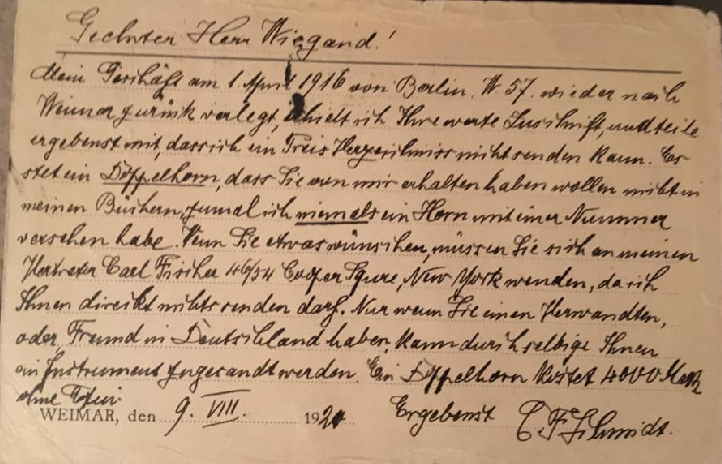
<<>>
April 1, 1916 moved
from Berlin to Weimar <<>>
|
|
C. F. Schmidt / Weimar früher Berlin |
|
|
Single B-flat with
stopping valve. Collection of Robert Ward,
San Francisco Symphony.
|
| C.F.
Schmidt/WEIMAR/früher/BERLIN |
|
|
F and B-flat double with
mechanical valve linkages, Robert Ward
collection:
"Plays very nicely, with a slightly
unusual focus and clarity that I find
vary appealing."
Previously owned by John (Giovanni) Rossi
(1927-2006), former member of The National
Symphony, Washington. In 1952, he moved to
New York and began a long career in opera,
symphony and recording, performing under
Leopold Stokowski, Sir Thomas Beecham, Max
Rudolf, Erich Leinsdorf, Karl Bohm and
many others. He played many musical shows
and on broadcasts, including the Bell
Telephone Hour and U.S. Steel broadcasts.
For 30 years, he played first horn on
summer concerts with the Goldman band.
|
| C.F.
Schmidt/WEIMAR/früher/BERLIN |
|
|
F and f descant double, with a very
unusual lever linkage to the piston change
valve. |
| C.F. Schmidt/Weimar/früher/BERLIN |
|
|
Stamped on the bell with "4523";
mercury dimes soldered to valve levers;
standing in B-flat; detachable bell is
silver plated inside; numerous patches;
some tubing has been replaced. Said to
have been played in N.Y. Philharmonic for
twenty years; possibly owned by Robert
Schulze and pictured in 1938
New York Philharmonic horn section.
Possibly brought to the U.S. by Mr. Shulze
when he came to the U.S. in 1911 at the
age of fourteen. |
| C.F. Schmidt/WEIMAR/früher/BERLIN |
|
1922 |
nickel-silver, with original F and Bb
pistons and optional A/E tuning slide with
tap; provenance confirmed to original
purchase in Germany. Collection
of Louis Denaro |
| C F Schmidt/&
Co./WEIMAR/früher/BERLIN |
|
|
Collection of
Louis Denaro |
| C F Schmidt/& Co./WEIMAR/ |
|
|
Purchased by Warren Dowdy in the mid
1990s from a band director in Brownsville,
Texas, now owned by his widow, Mrs. Hazel
Dowdy. |
| C.F. Schmidt/Weimar/Carl Fischer New
York/Sole Agent of USA and Canada |
31197 |
ca. 1923 |
Silvered detachable bell. Replacement
leadpipe, main tuning slide, evidence of
other work. Private Collection in
U.S. |
| C.F. Schmidt/Weimar/Carl Fischer New
York/Sole Agent of USA and Canada |
31384 |
|
Purchased used about 1961 from a player
in a San Diego professional marching and
concert band who was retiring. |
C.F.
Schmidt/Weimar/Carl Fischer New
York/Sole Agent of USA and Canada
|
31429
|
|
Previously
owned by Charles Kavalovski, now
since 1978 by Robert Ward, San
Francisco Symphony |
| C.
F. Schmidt/Weimar/Carl Fischer New
York/Sole Agent of USA and
Canada/32110 |
32110 |
|
Purchased by Mike
Robinson in December 2017 from Kevin Bowen
a horn repairman in the Atlanta
area. According to Mike, "The
horn is in excellent condition for a 90
year old instrument! The horn is
completely intact except that the leadpipe
has been replaced with a Dan Rauch Schmidt
leadpipe. The valves have been redone by
Chuck Ward and the previous owner Kevin
made sure everything was in perfect
working order.
Kevin also added the articulated linkages
on all three valves... and wow do those
valves fly! The horn plays like a charm! a
great sound and a joy to play!"
|
| C. F. Schmidt/Weimar/Carl Fischer New
York/Sole Agent of USA and Canada/32112 |
32112 |
|
Currently (2011) in Cleveland, OH;
Purchased ca. 2001 from a public school
teacher who purchased it in New York in
the 1950s. Generally good playing
condition, great sound, solid high
register. |
| C.F. Schmidt/Weimar/Germany/Carl
Fischer New York/Sole Agent of U.S.A. and
Canada/32652 |
32652 |
|
This horn was originally owned by Jerry
(Jaroslav) Knopp, formerly with the
Baltimore Symphony, Chicago Civic Opera,
and a member of the All American Youth
Orchestra that Leopold Stokowski took to
South America in 1940. It was sold in 1960
to the present owner, Mr. Bruce Kovacs
|
| C.F. Schmidt/Weimar
Germany/ Carl Fischer New York/Sole Agent
for U.S.A. and Canada.
|
|
|
Dale Clevenger purchased
his C.F. Schmidt double horn in 1959 from
Imogene Sloan
and used it in the Chicago Symphony
Orchestra until 1975 when he replaced it
with one made by Steve Lewis. Mr.
Clevenger states "My two CF Schmidts are:
one a double made in about 1912 in Weimar
and a single Bb made in Berlin about 1921.
Neither label has a serial number, but I
know the workmanship of the old man
Schmidt (Geyer taught me) and I know when
he died, in 1921. So, I have a pretty good
idea of the dates of these horns even
without the serial numbers." Subsequent
research on the dating of C.F. Schmidt
instruments suggests a later date for this
horn.
|
| C.F. Schmidt/Germany
Weimar Germany/Carl Fischer New York/Sole
Agent of U.S.A. and Canada/32665 |
32665 |
ca. 1929 |
This is one of those lucky
finds that players and collectors only
dream about. It was found in an antique
shop in Maine on June 16, 2012, and
purchased for $175. The horn is in
excellent condition, plays very well, and
came complete with original case, F and
E-flat tuning slides, and E/A crook with
quick change tap. The label is unusually
engraved with "Germany" written twice.
|
| C F Schmidt/&
Co./WEIMAR/fruner [sic] /BERLIN |
32958 |
|
The label on this horn
is very ornately embellished with
scroll-work, not seen on other C.F.
Schmidt horns. In addition the serial
number is unusually high for the wording
of the label and there is no reference
to Carl Fischer as agent as on all other
horns with serial numbers. The word
"früher" is misspelled. The most
troubling engraving on the horn,
however, is the notation "Spezial
Fur Prof. F. Gumbert." This is
rather amateurishly written in cursive
penmanship. The word "für" is
incorrectly capitalized and is
misspelled, missing the umlaut.
Friedrich Adolph Gumpert (1841 - 1906)
was a famous solo horn in the Gewandhaus
Orchestra, Leipzig, and teacher of many
fine horn players and was still living,
although retired, when the C.F Schmidt
double horn was invented in ca. 1900.
Furthermore the label Weimar früher
Berlin does not seem to fit the supposed
location of the C.F. Schmidt in that
period. The horn was sold on eBay
in 2012 and was previously owned by an
amateur player who purchased it from
Giardinelli in New York in the 1960s.
Prior provenance is unknown. |
The Tariff Act of 1930
(P.L. 71-361) was an act, sponsored
by United States Senator Reed Smoot
and Representative Willis C. Hawley,
and signed into law on June 17, 1930
imposing tariffs on goods imported
into the United States. Among its
provisions is the requirement that
imported goods must be conspicuously
and indelibly marked in English to
indicate to the ultimate purchaser
the country of origin. So, it seems
reasonable to presume that C.F.
Schmidt horns marked "Made in
Germany" were imported for sale in
the U.S. in or after 1930.
|
|
C. F. Schmidt & Co. /Weimar/
Made in Germany |
|
|
Owned by Henry M. Viets, Santa Rosa
Symphony; previously owned by David
Krehbiel. The horn now has a Bruce
Roberts leadpipe.
|
| C.F. Schmidt/Weimar/Carl Fischer New
York/Sole Agent of USA and
Canada /Made in Germany |
33561 ? |
|
Nickel (or probably silver) plated over
brass; listed on eBay 7/20/08 for $3800 in
Tuscaloosa, AL, but no bids. Estimated by
seller to date from ca. 1914 |
| C.F. Schmidt/Weimar |
3455? |
ca. 1927? |
For sale in the U.S. Date estimated by
seller. |
| C. F. Schmidt, Weimar/
Carl Fischer New York/ Sole Agent of
U.S.A. and Canada, /Made in Germany/34727
|
34727
|
ca. 1930
|
Owned by Warren Brown and
restored in 2025 by Ion Balu in Chicago
|
C.F.
Schmidt/Weimar/früher/Berlin/Carl
Fischer New York/Sole Agent of U.S.A. and
Canada/Made in Germany/34840
|
34840
|
1924/25
|
Nephew of original owner
states the instrument was purchased new in
1925/1926 which is consistent with label,
however "Made in Germany" and serial
number suggest post-1930.
|
| C F Schmidt / Weimar Germany / Carl
Fisher New York / Sole Agent of USA and
Canada / Made in Germany/35611 |
35611 |
1930 |
Collection of
Louis Denaro |
| C. F. Schmidt/Weimar/Carl Fischer New
York/Sole Agent of U.S.A. and Canada/Made
in Germany/36590/ |
36590 |
|
Single F horn, bell has been
transferred to another horn of various
maker's components |
| C.F. Schmidt, Weimar, Carl Fischer New
York, Sole agent of USA and Canada, Made
in Germany, 36789 |
36789 |
ca. 1932? |
Offered on eBay on 10/6/09, in
Pittsburgh, PA. Date estimated by seller.
Additional S/N 1371 on piston casing. |
| C.F. Schmidt/Weimar/Carl Fischer Inc.
New York/Sole Agent of USA and Canada/Made
in Germany/37022 |
37022 |
|
|
| C.F. Schmidt, Weimar, Carl Fischer New
York, Sole agent of USA and Canada, Made
in Germany, 37835 |
37835 |
|
|
C.F. Schmidt, Weimar, Carl
Fischer New York, Sole agent of USA and
Canada, Made in Germany, 37953
|
37953 |
|
Double horn in F and Bb
owned by Lyle Adley-Warrick |
| C.F. Schmidt, Weimar, Carl Fischer New
York, Sole agent of USA and Canada, Made
in Germany, 37994 |
37994 |
|
Listed on eBay on October, 24
2009 |
| C.F. Schmidt, Weimar, Carl Fischer New
York, Sole agent of USA and Canada, Made
in Germany |
38290 |
|
Purchased in 1969 from John Lounsbery
of the Milwaukee Symphony, for $400. Used
as primary horn until 2008. Estimated by
John Barrows to date from 1920, however
S/N would indicate later. Overhauled in
1973 by Jerry Lechniuk (Chicago) and bell
silver plated by Anderson Silverplating
(Elkhart). |
C.F. Schmidt,
Weimar, Carl Fischer New York, Sole
agent of USA and Canada, Made in Germany
|
38506
|
|
Double horn purchased in
2024 by Jonathan Ring from an estate sale
in Los Angeles in excellent original
condition complete with the E/A/tuning
slide, Bb/F piston and original case.The
piston had been replated and the horn
plays great with a wonderful, resonant
sound reminiscent of that Dale Clevenger
tone
|
| C.F.
Schmidt, Weimar, Carl Fischer New York,
Sole agent of USA and Canada, Made in
Germany |
38783 |
ca. 1934 |
Son of original owner stated that this
horn was used by his father in his high
school band from 1934 through 1938.
Believed to have been purchased new.
Private collection in U.S. |
| C.F. Schmidt/Weimar/Carl Fischer Inc.
New York/Sole Agent of U.S.A. and
Canada/Made in Germany/39048/ |
39048 |
|
Owned by James Tankersley of the
Houston Symphony during the 1950's-1960's.
Listed on eBay April 28, 2011, now
owned by Richard
Burdick, 1st Horn of Regina Symphony
|
| C.F. Schmidt/Weimar/Carl Fischer Inc.
New York/Sole Agent of U.S.A. and
Canada/Made in Germany/39079/ |
39079 |
|
Purchased in 1988 for a student in
Costa Rica, and as of January 2011, this
horn was still located in Costa Rica. |
| C.F. Schmidt/Weimar/Carl Fischer Inc.
New York/Sole Agent of U.S.A. and
Canada/Made in Germany/39593/ |
39593 |
|
Said to have been once owned by Luigi
Ricci |
| C.F. Schmidt, Weimar, Carl Fischer New
York, Sole agent of USA and Canada, Made
in Germany 39732? |
39732? |
ca. 1930? |
Sold in Japan. Date estimated by
seller. |
|
C.F. Schmidt
Weimar
Carl Fischer -
In - New York
Sole Agent of
U.S.A. and Canada
Made in
Germany
39746
|
39746 |
|
Single F with
original F tuning slide crook.
Engraving faded and a bit hard to
read.
Mark Almond Collection
(Ring: Serial # could be 39796 but I
think it says 39746)
 |
| C.F. Schmidt/Weimar |
|
|
For sale in U.S. |
C.F. Schmidt/Weimar/Carl Fischer Inc.
New York/Sole Agent of U.S.A. and
Canada/Made in Germany/40246
|
40246
|
|
Since 1983 owned by Suzanne
Chasalow, Santa Rosa Symphony
,
formerly with the Boston Brass,
Bay Area Women's Philharmonic, Western
Opera Theatre Freelance with other local
groups. Previously
had a Lawson leadpipe now has
a custom Bruce Roberts pipe.
|
|
C.F. Schmidt
Weimar
Carl Fisher inc. New
York
Sole Agent of USA and
Canada
Made In Germany
40904
|
40904 |
|
Since 2005
owned by Darby Hinshaw, San Diego
Symphony, and former owners include
Forrest Standley and Gene Standley. The
horn stands in F and has a .468" bore in
the valve section, with considerable
reductions in the tighter bends.
It's been played heavily, and the wear
level is high. The valves have been
nickel plated by Lawson and are
fantastically tight and smooth. The
inside of the bell was silver plated at
some point, and the inside of the
detachable bell has very heavy pitting,
but still plenty of metal remains. The
original lead pipe is long gone, and it
currently has a very fine pipe by Bruce
Roberts. It's not in showroom condition,
but a good example of a
very-high-mileage instrument with many
years left in it. |
| C.F. Schmidt/& Co./WEIMAR/Cont.
Music Co. New York/Agent of USA and
Canada/Made in Cermany[sic]/41059 |
41059 |
|
In 1925 C.G. Conn created it's
wholesale division, Continental Music
Corporation in Chicago. Ca.
1930, it purchased much of the musical
instrument stock of Carl Fischer. Bell
exhibits unusually ornate engraving.
Several modifications. Offered for sale in
St. Louis, 3/31/2010 |
|
C.F. Schmidt
uCo.
Weimar
Continental Music Co.
Chikago [sic.]
Agent of U.S.A. and
Canada.
Made in Germany.
|
|
|
Owned by Stephen Laifer of
the Rochester Philharmonic Orchestra.
It is difficult to estimate the date of
this horn, however "Made in Germany"
suggests that it was imported after 1930
and that Carl Fischer was no longer the
"sole" importer. The misspelling of
Chicago further suggests that the
engraving was done in Germany using the
same tool as the rest of the label.
|
| C. F. Schmidt/ &
Co. /Weimar/ Made in Germany |
|
|
Purchased on
eBay in 2023 by Jonathan Ring.
The build quality seems somehow
rougher than earlier C.F.-built
instruments (slide tube lengths not
all equal, nickel slide tubing, possible
different piston supplier, etc.) which
suggests that this one is quite
late and possibly put together using
whatever parts were available
post WWll towards the end
of horn production.
|
|
|
|
|
* Serial
numbers were added by Carl Fischer. In
response to an inquiry about archives a
spokesperson for Carl Fischer, Inc. has
replied: "Our instrument division closed
decades ago and we no longer have
records."
**Dates are estimates or
guesses usually made by recent owners and
should not be taken to be accurate. In
some cases where early provenance is known
dates given may be more certain. Horns are
listed by wording of the C.F. Schmidt
label which are believed to be in
chronological order. |