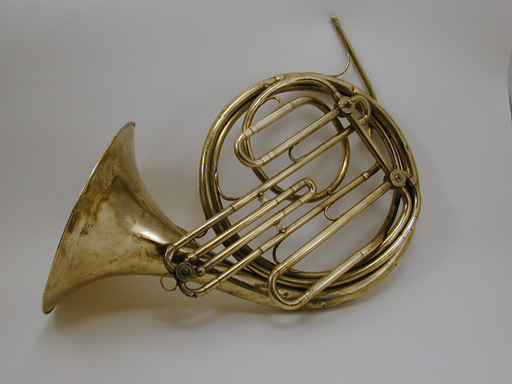
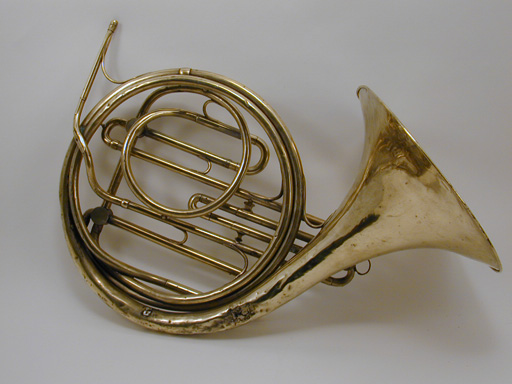
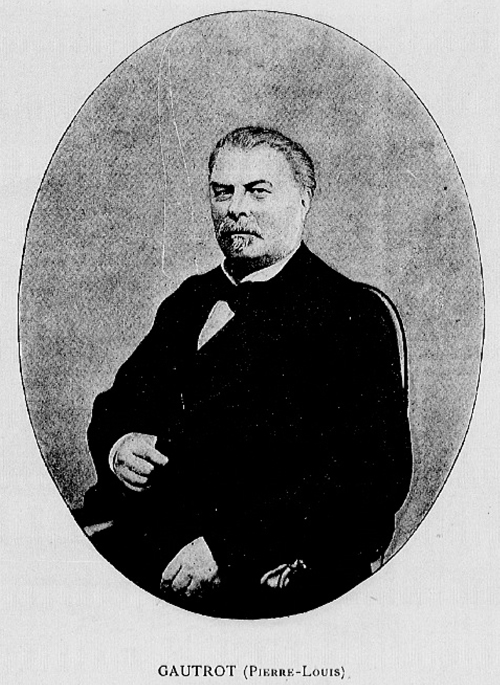
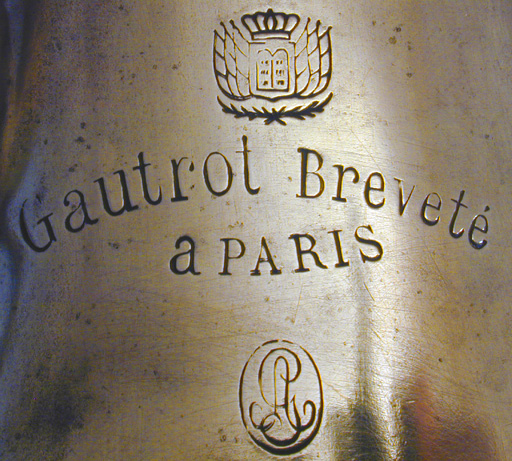
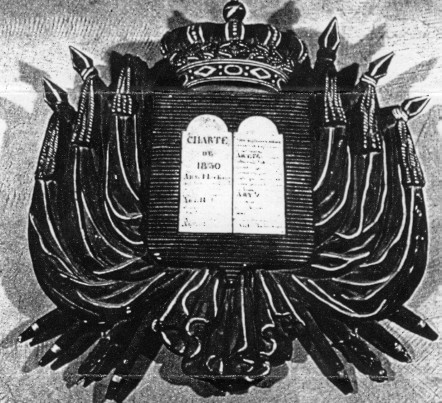
Arms of France, 1831-48, as they
appear at the top of a frame surrounding a portrait of
Louis-Philippe, workshop of Winterhalter. The portrait
and frame were sent in 1848 to King Kamehameha III of
Hawaii and have stayed there since. (Source: Collection
of the State of Hawaii, The Friends of Iolani Palace
http://www.heraldica.org/topics/france/frarms.htm)
|
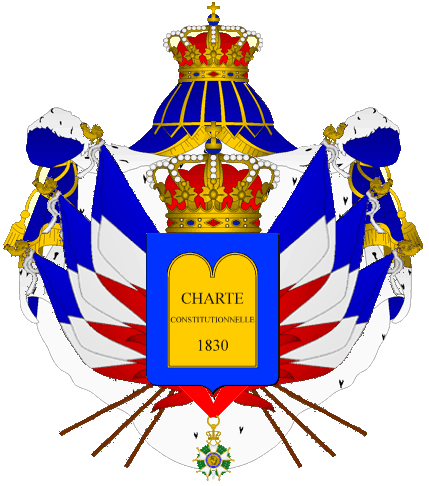
The Ordonnance of Feb. 26,
1831 reads: À l'avenir, le sceau de l'État
représentera un livre ouvert portant à
l'intérieur ces mots "Charte de 1830",
surmonté d'une couronne fermée, avec le
sceptre et la main de justice en sautoir, et des
drapeaux tricolores derrière l'écusson, et
pour exergue "Louis-Philippe Ier, Roi des
Français". That is, an open book with the words
"Charter of 1830", (the shield) surmounted by a closed
crown; behind the shield, in saltire, were the scepter
and hand of justice, as well as tricolor flags. King
Louis-Philippe abdicated the throne but the strong
current of public opinion rejected the nomination of his
son, Phiippe, as the new monarch. On February 26, the
Second Republic was proclaimed and Prince Louis Napoleon
Bonaparte was elected President in December. A few years
later he declared himself president for life and then
Emperor Napoleon III. This image is a file from the
Wikipedia Commons.
|
<<>>Musical
Politics in France<<>>
On April 22, 1845 a public comparison
of bands was held on the Champs-de-Mars: one assembled
by Adolphe Sax versus one assembled by Michele Enrico
Carafa, director of the Gymnase de Musique Militaire
where most musicians of the army were trained.
Reportedly, over 20,000 spectators were present to
witness the contest between Sax, who wanted to
reorganize the military bands to incorporate his line of
saxhorns, and Carafa, who advocated retaining the
traditional instrumention including natural horns. Sax
was the clear victor and the new order that came on
August 19th, 1845 specified four cors à
pistons and no natural horns, as well as a full
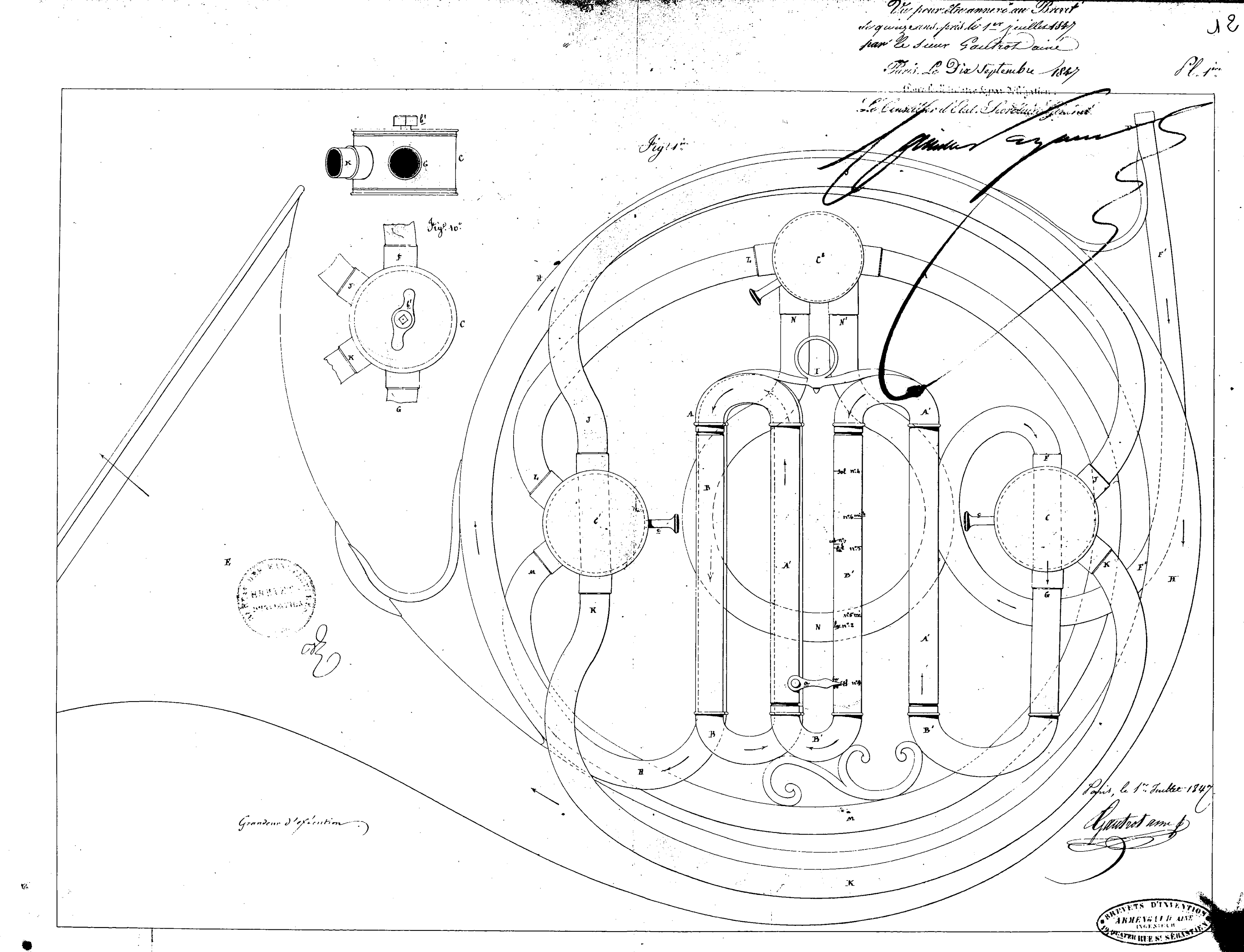
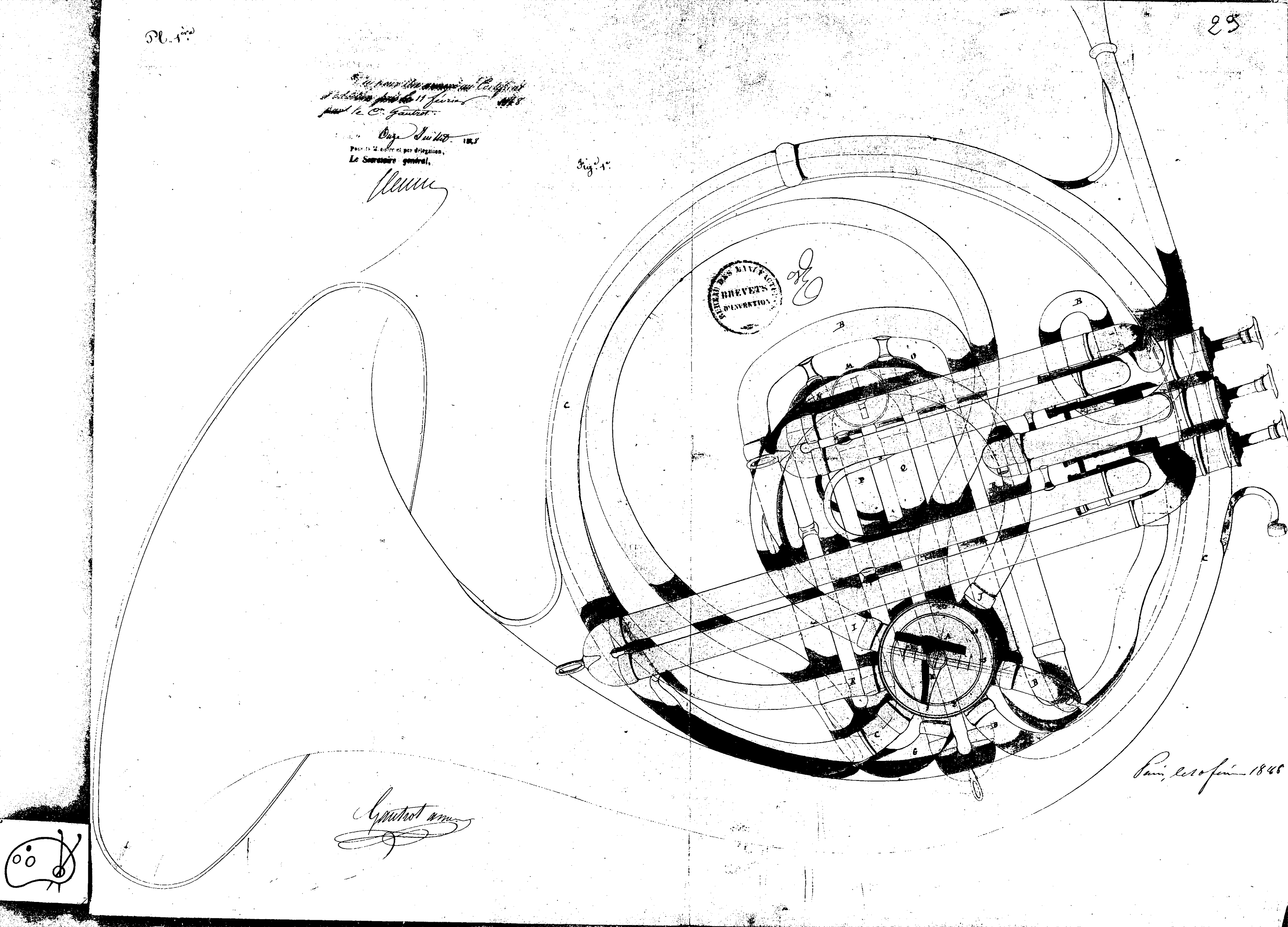
complement of saxhorns. Although the omnitonic horn
patent was issued in 1847, it was probably in
development much earlier while natural horns were still
in the military band complement. It would seem likely
that this was Gautrot's target market. The order of 1845
eliminating natural horns along with the apparent
disinterest on the part of the faculty of the
Conservatiore and orchestral musicians, the market for
the omnitonic horn all but disappeared, although it
would appear from the patent that M. Gautrot persisted
in their development.
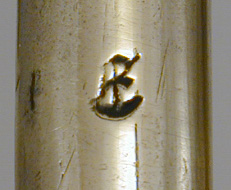
On February 24, 1848, under public pressure
Louis-Philippe suddenly abdicated the throne of France
in what became known as the Revolution of 1848. This
event certainly to puts an upper bound on the making of
the subject horn implying that this horn was
manufactured and stamped was prior to dissolution of the
monarchy and the disuse of these arms. This date
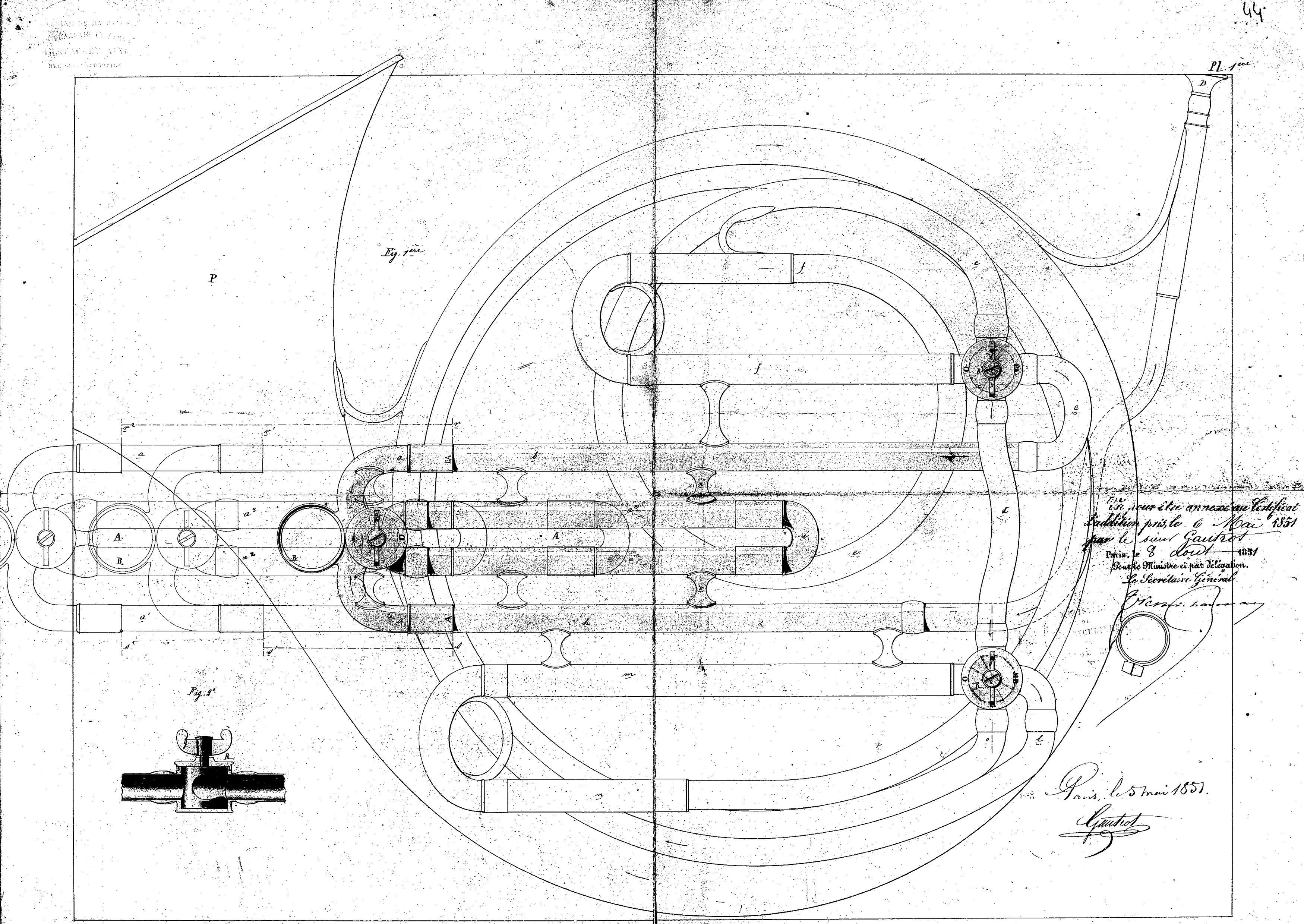
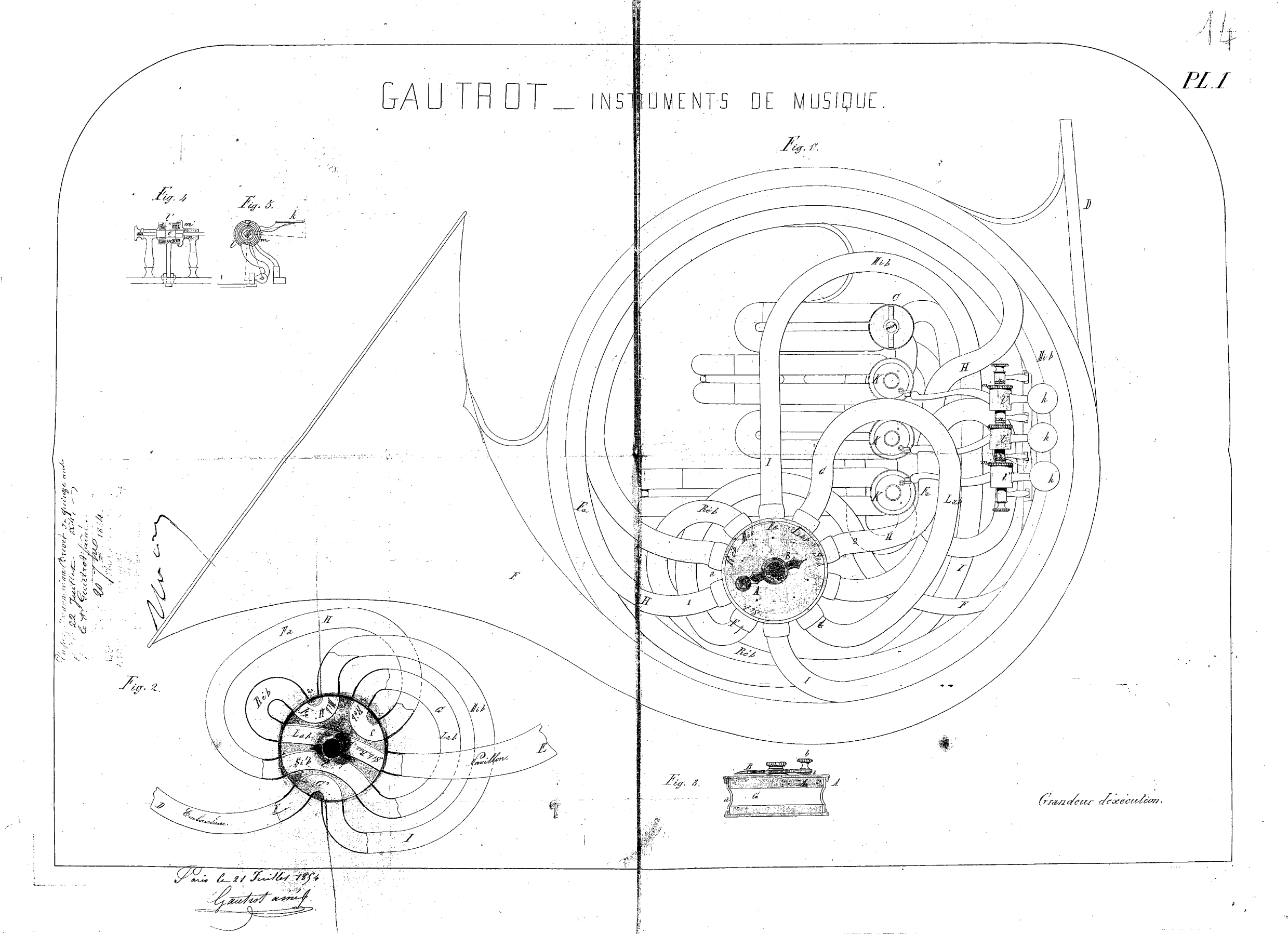
contradicts the date of the Addition 3 to
Brevet 5874 (May 6, 1851). One possible theory is
that the horn was designed and built in time for the
Carafa-Sax competition in 1845 to support the argument
for natural horns in the military by eliminating the
need for carrying a large box full of terminal crooks.
With the order to replace natural horns with valved
horns, the omnitonic prototype became un-marketable and
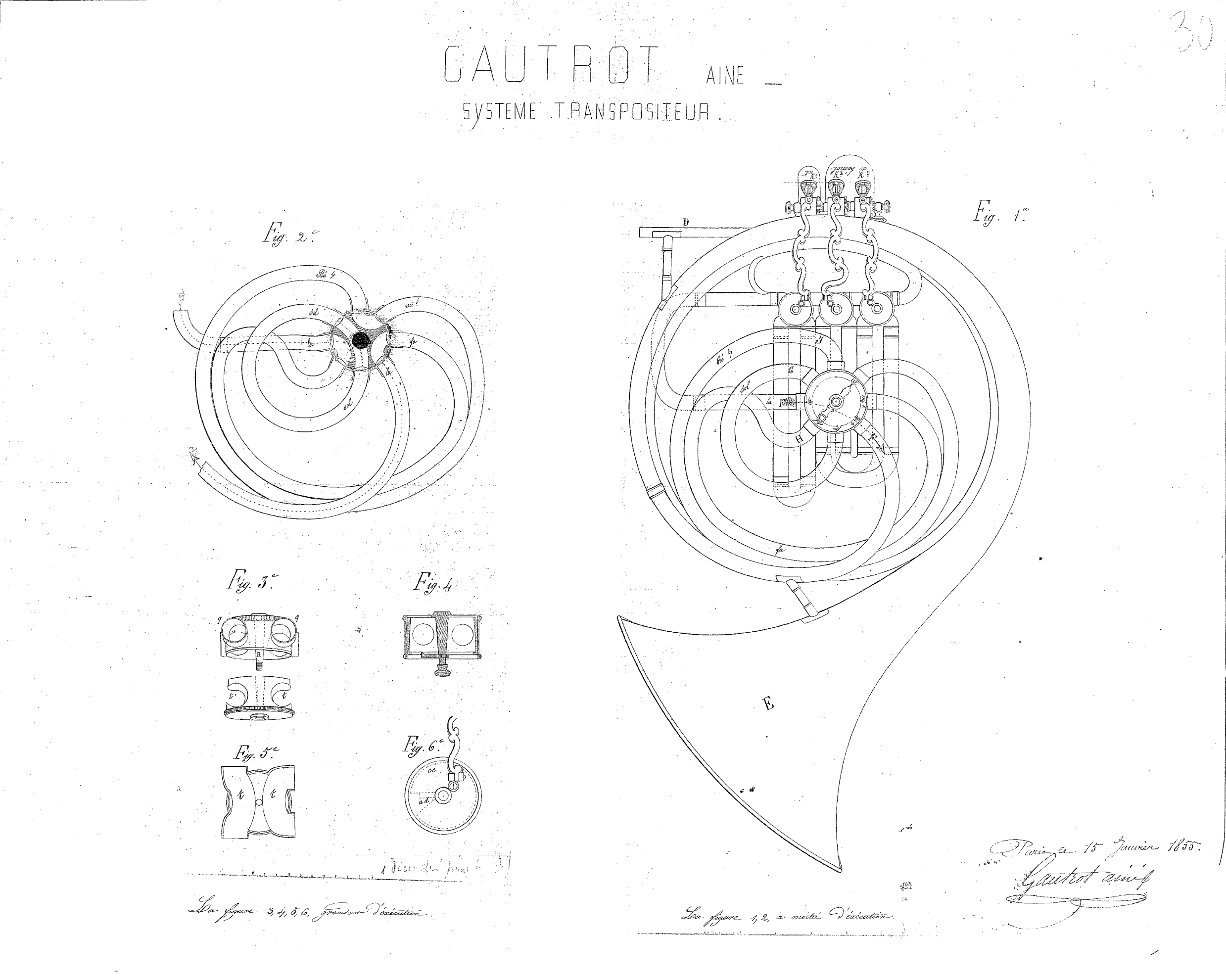
was set aside. In 1847 M. Gautrot resurrected the idea
with two improved versions, first by making the central
tuning slide primary means of changing the key, then
incorporating the Cerveny's Tonwechsel-Maschine, which
he also used in subsequent designs (see below). Then in
1851 he decided to give his original design (the subject
horn) patent protection, claiming it was somehow
actually an improvement.
[4]
1848 also became a very difficult year for music,
musicians, and instrument manufacture in France:
Les fabricants d'instruments de cuivre,
qui en 1847 avaient vu le chiffre de leurs affaires
commerciales s'élever à 1,620,500 fr.
et qui occupaient, à Paris seulement, 461
ouvriers, virent ces mêmes affaires se
réduire 923,500 francs et furent
obligés de renvoyer 102 ouvriers.
[Pontcoulant,Organographie, Tome
2, p.468]
Manufacturers of brass instruments, which in 1847 had
seen the total of their business reach 1,620,500 fr.
and had occupied in Paris alone 461 workers, saw these
same figures reduced to 923,500 francs and were forced
to dismiss 102 workers.
The general depression affected all instrument
manufacturers in a similar manner. The
Opéra-National and lyric theatres were forced to
close, musicians and singers were put out of work, and
the "cloud of concerts" that usually took place in Paris
disappeared.
Immediately following the fall of the monarchy, Carafa
sought his revenge on his defeat by Sax in 1845-6. He
persuaded the Ministry of War to reverse the order of
1846. As a result the order of March 21, 1848 reinstated
the two cors ordinaires (natural horns) and the
saxhorns were replaced with traditional instruments much
to the dismay of the musical press who perceived this a
huge step backward. This would seem to have been
favorable for Gautrot's omnitonic horn which is
essentially a natural horn without the cumbersome box
full of terminal crooks.
<<>>A
Franco-Mexican Connection<<>>
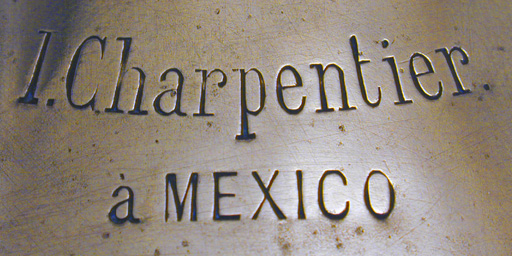
An inscription on the bell identifies "I.
Charpentier à Mexico" (perhaps a sales
representative for Gautrot or horn player).
As cited previously,
Gautrot held thousands of instruments in stock in
1847, which undoubtedly included some quantity that
were already stamped with the arms of the monarchy and
were thus no longer marketable in France. This
circumstance, along with the generally depressed state
of the music business in France in 1848, compelled
Gautrot to put this instrument out for export. He was
probably already seeking to develop his export market
which by 1860 was reported to be 70 percent of his
output. Presumably M. I. Charpentier was Gautrot's
representative in Mexico. The war between Mexico and
the United States was just ending; the Peace treaty
was signed on February 2, 1848, almost simultaneously
with the fall of the French monarchy. Nancy Nichols
Barker summarizes France's relationship with Mexico
under Louis-Philippe as follows:
The Orleanist government simply
had no Mexican policy in the decade of the 1840s.
The government had just sense enough not to repeat
the naval action of 1838-39 but found nothing to
take its place. Conscious of its ineffectiveness, it
sulked and snapped, and, while professing officially
its desire to live on good terms with Mexico,
maintained representatives in the field with
manifestly hostile intentions. Objects of ridicule
and scorn, these agents hindered, instead of
helping, the interests they were there to serve.
French subjects in Mexico were left to their own
devices to cope with the civil wars and Francophobe
administrations. French commerce never recovered
from the blows dealt it by the French war of the
previous decade and by 1847, when Mexico was under
the American blockade, it all but ceased entirely.
It was of course true that many of the elements
necessary for the prosperity of the French in Mexico
were beyond the control of the French government.
Nevertheless, the policy of laissez-faire, at least
as practiced by the so-called bourgeois monarchy,
proved more curse than blessing to its subjects and
trade in Mexico. Its deplorable record might well
serve to demonstrate to a more energetic and
visionary French ruler the perils of aimless drift
and the need for a bolder course.
The French Experience in Mexico
1821-1861, p. 116
Relations between France and
Mexico improved almost immediately following the fall
of the French monarchy. André Nicolas Levasseur
was appointed the new minister plenipotentiary to
Mexico. Soon trade was restored between the two
countries and the Mexican army was rebuilding under
the French model with the newest weapons, training,
and perhaps even French musical instruments.
It would be improper, in
speaking of the Mexican military, not to notice,
especially, their excellent bands of music. ... It
is the custom for one of the regimental bands to
meet after sundown, under the windows of the Palace,
in the Plaza, which is filled with an attentive
crowd of eager listeners to the choicest airs of
modern composers.
Mayer, Brantz. Mexico as it was
and as it is, Third Edition. Philadelphia:
G. B. ZIEBER & COMPANY, 1847. p. 287
Levasseur's first official
assignment was to canvass the French community and
produce a "register" of French citizens. In
characterizing the French community in Mexico at
mid-century, Barker states:
The French had become something like a
small state within a state. They seem to have mixed
very little in Mexican society except at the
official level. The French minister formed social
ties with prominent Mexicans, attended the opera,
and received Mexican guests at the legation. But he
was an exception. Those who could afford it, careful
to preserve their national identity, sent their
children to French-speaking schools and subscribed
to French newspapers. The working classes kept much
to themselves, spending their days in their shops
and their evenings or other free time at a
café or in a game of boules. Not even to
attend mass did the French need to mix with
Mexicans, at least in the capital. In 1849 Levasseur
reported the consecration of a church especially for
French use. Beneath vaulted arches hung with the
tricolore the French curé presided over their
spiritual life and the more dignified, sober
displays of French patriotism.
Why did the urban Frenchman in Mexico cling so
tenaciously to his qualité de
français and resist assimilation into
Mexican society? One reason no doubt was the
relatively short time he had had to learn the
Spanish language or to adopt a Mexican life-style.
For almost without exception the French in Mexico at
mid-century were first generation. Only 3 in
Levasseur's survey gave Mexico as their place of
birth, and none of these can be proved to have been
in Mexico as early as 1820. Only 12 had been born
elsewhere in the Americas. Indeed, only 47 out of
the entire 1,810 on Levasseur's list had been born
outside the French métropole. The French were
thus newcomers not only to Mexico but to the New
World in general. The earlier French of the
eighteenth century had departed, and a new generaton
had replaced them.
op. cit., Barker, pp. 130-131.
With both local and touring
productions beginning around 1830, Italian opera
enjoyed some popularity in Mexico. It was not without
its ups and downs, however:
I have said, that this musical taste
pervades all classes; and it was, therefore, to be
hoped, that a regularly established Operatic corps
would have readily succeeded in the Capital. But
from a variety of causes the experiment failed. The
Revolution of 1841, interfered with it at the
outset, in the months of August and September; and,
from the unfavorable location of the house, and
other circumstances, the whole enterprise was
visited with a series of disastrous losses that left
the management, in July, 1842, with a deficit of
upward of 32,000 dollars. The singers were good: the
prima donna (Madame Castellan,) and basso,
unexceptionable; but the establishment never became
fashionable.
[op. cit., Mayer, p. 287]
By 1847 when this horn was made, however, the situation
began to improve and the instrument might have been
employed in the opera orchestra rather than the military
band.
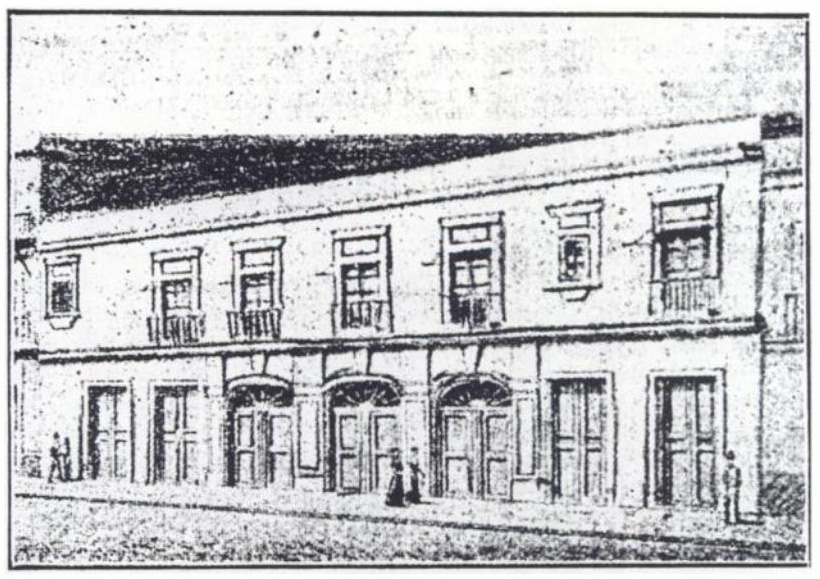
The History of North American
Theater: The United States, Canada, and Mexico,
p. 149
Of the several theatres in
Mexico City at mid-century the two leading were the
remodeled Teatro Principal (above) and El
Gran Teatro Nacional (below) built in honor of
Santa Anna in 1844. On May 15, 1850 the Teatro
Nacional presented Verdi's "Ernani" to the
Mexican public featuring la Compañía
de Ópera Valtellina-Duvercy under the
direction of Antonio Barilli. This was the first
performance of a Verdi opera in Mexico. The following
year, Max Maretzek presented "Don Giovanni" said to be
the first performance of a work by Mozart in Mexico.
Other Mexican venues include the Gran Teatro
Iturbide (1845, later named Teatro de la
República) in Santiago de
Querétaro, and the Teatro Alarcón
in Guadalajara which opened in 1856 with Donizetti's
"Lucia di Lammermoor".
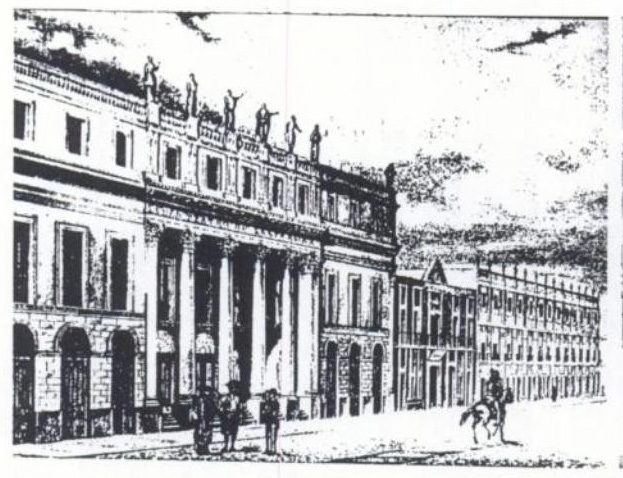
The History of North American
Theater: The United States, Canada, and Mexico,
p. 154
Brantz Mayer (Mexico as it was and as it is, p.
45) describes the Catte Platens in Mexico City
as "a street filled with the shops of goldsmiths,
watchmakers, French hairdressers, French cooks, French
milliners, French carvers and gilders, and French
print-sellers;". Apropos of the latter the amount of
French books exported from France to Mexico in 1846 was
close to 9,000 kgs, and "the figures for Mexico will
grow to 26,284 kgs in 1849 and 37,586 kgs in 1850." By
1851 "Mexico received 44,327 kgs of French books, or
more than Brazil (33,847 kgs) and only some 15,000 kgs
under the figure for the United States. Book exports to
Mexico decrease after that year, but remain high (e.g.,
22,917 kgs in 1860, in the midst of the civil war)."
Rodrguez-Luis, Julio. "Book Exports From
Spain and France to Latin America in the Nineteenth
Century", pp.22, 23 (Note: The author emphasizes that
the data represents weight and not individual books,
and that "books" might represent any type of printed
matter.)
|