Adolf V. Belz was
born in Prussia in January, 1842, and "studied under the
best instructors of Germany". Before coming to the
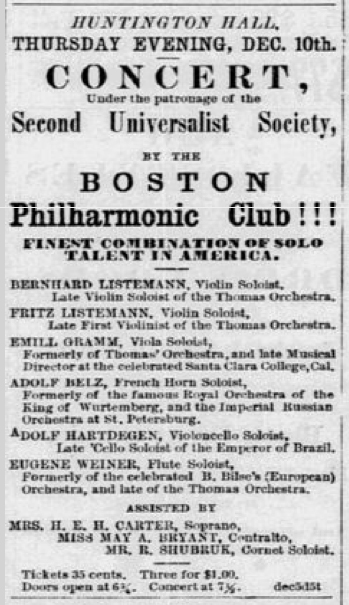
United States he was a member of the the Royal Orchestra
of the King of Wurtemburg. He was engaged as a solo
performer with the Imperial Russian Orchestra at St.
Petersburg where he won great distinction. In 1872 he
came to the United States with the Russian
Horn Quartette. Mr. Belz joined the New York
Philharmonic for the 1873 - 1874 season appearing as
fourth horn for the November concert then moving to
third horn. The following year a new "Philharmonic Club"
was formed in Boston and Mr. Belz became its solo horn.
He was also listed (1891) as the principal horn in the
Symphony Orchestra of New York, under Walter Damrosch.
In September, 1893 however, he was one of twenty members
(including fellow horn player B. Riese) not rehired by
Mr. Damrosch for the coming season. No reason was given
by Mr. Damrosch. In April, 1895 he was engaged as
principal horn of the Boston Festival Orchestra for the
New Bedford Massachusetts Choral Society Festival. In
1903 Mr. Belz was recruited by composer, critic, and
conductor Reginald De Koven to be second horn in the
short-lived Washington D.C. Symphony.
On July 8, 1892 Mr. Belz' first wife, Julia (b. 1844)
died; He remarried in 1898.
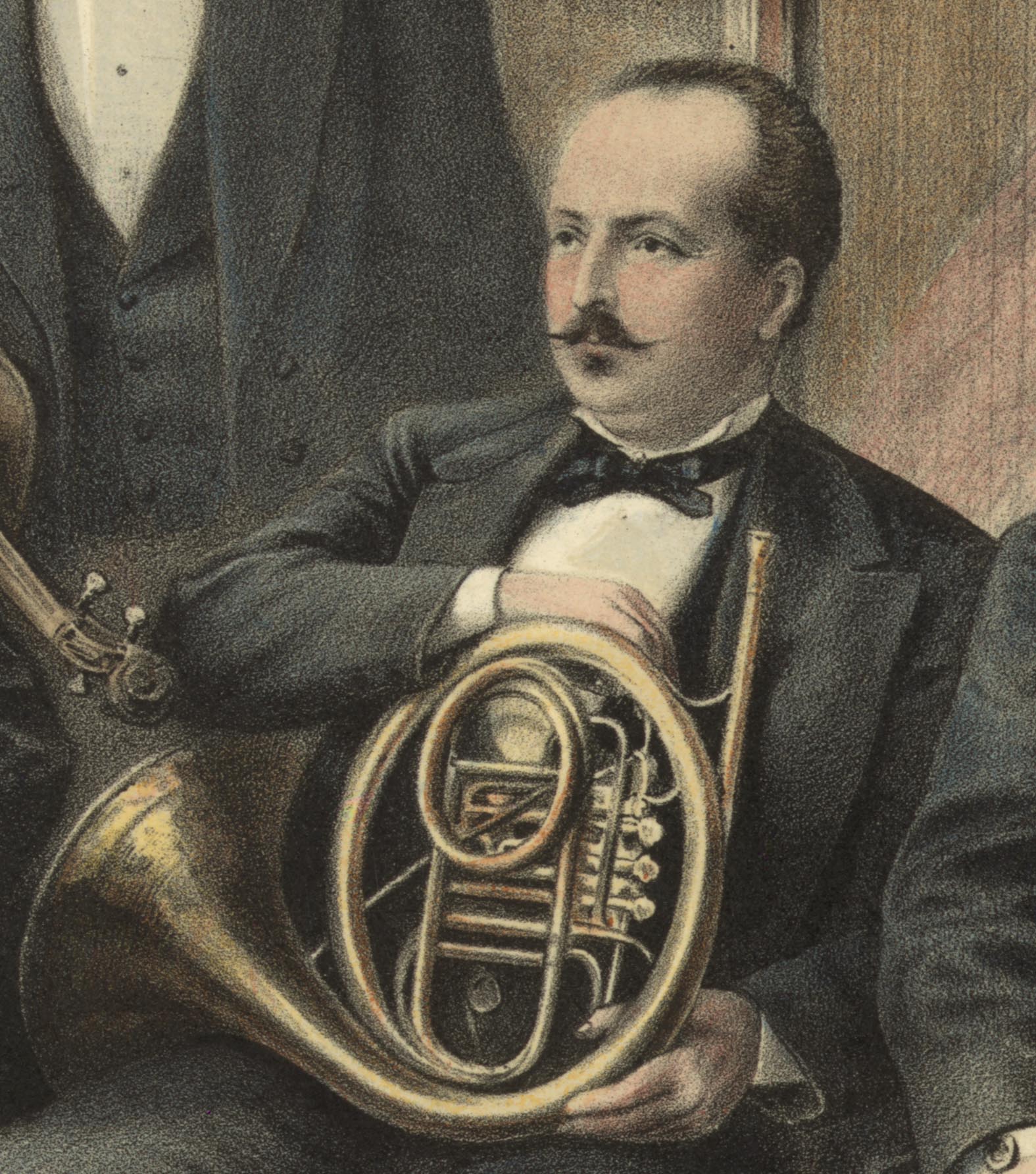
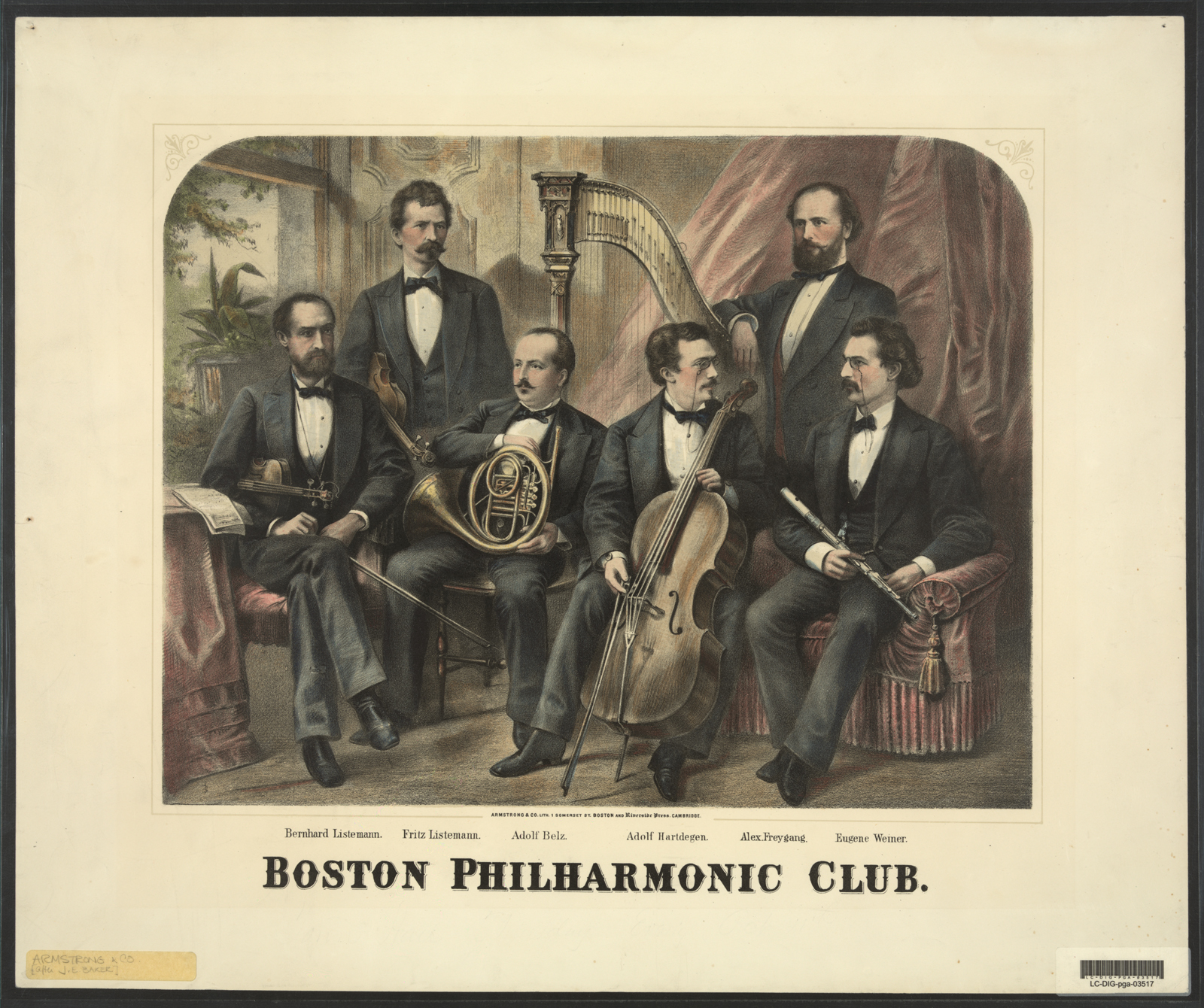
The horn he is shown holding in the above lithograph is
probably the one of "a valuable metal composition" given
to him by the King of Wurtemburg. It is a typical German
design probably pitched in F, with fixed leadpipe and
bell garland. It appears that the artist has exercised
some license with the details, including the curious
strap or tube running diagonally through the body.
Repertoire:
Solos performed with the Boston Philharmonic Club
included "Air d'Eglise" (Stradella), "Troubadour Fantasy
for French Horn" (Belz), "Am Meer" (Schubert), "Song
Without Words", op. 30 (Mendelssohn)
Reviews:
"Mr. Adolph Belz showed himself a master of the French
horn and his fantastic solo on the that lisping
instrument, the flute, gave us most pleasure, although
we confess anything like discrimination would be mainly
a matter of taste." (Worcester, Massachusetts Gazette
quoted in the Fitchburg Daily Sentinal, March 27, 1875).
"Adolph Belz is one of the prominent solists of this
[Boston Philharmonic] club and the finest performer on
the French horn that has been heard in this country,
possessing the most consummate master over that
instrument. The one he plays is of a valuable metal
composition, and a present from the King of Wurtemburg."
(Fitchburg Daily Sentinel, April 1, 1875)
"...a Fantasia for the French horn, by Adolph Belz, who
showed that this somewhat undervalued instrument could,
in the hands of such an artist as himself, produce the
most exquisite music." (Indianapolis Sentinel, April 24,
1875)
"Mr. Adolph Belz's interpretation on the French horn of
Stradella's prayer was a delicious novelty..." (New
York Times, February 18, 1876).
"Mr. Belz is a horn player of exceptional eminence, with
a tone superior to anything we have heard recently..." (The
Cleveland Leader, February 26, 1876)
"To Mr. Belz, the French Horn soloist, was given one of
the most cordial encores of the evening. His instrument,
strange to so many here, pleased every one, and he is to
be congratulated on his success." (The Princetonian,
Princeton College, January 24, 1878)
|
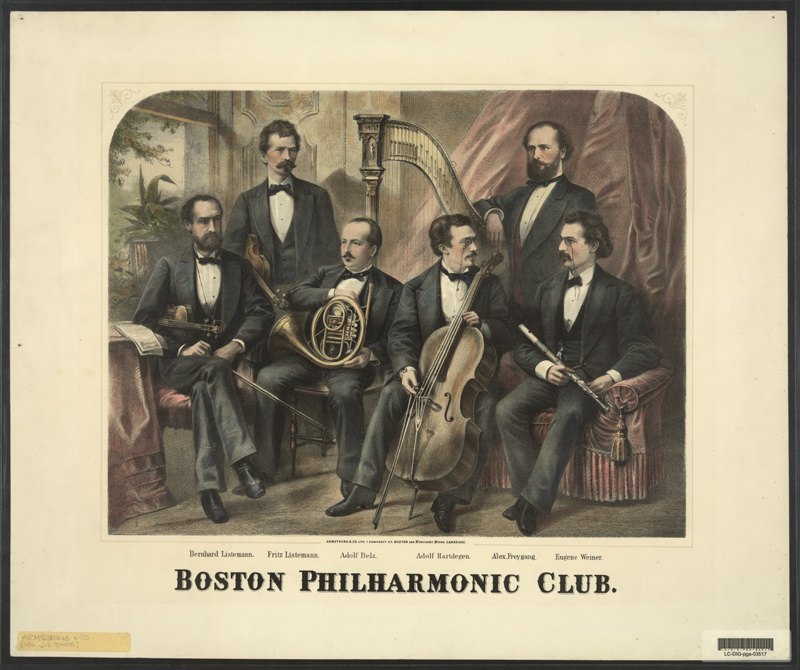
The Boston Philharmonic Club was founded by
Bernhard Listemann in 1874 and for four years toured the
United States, predominantly in New England and the
Midwest, giving chamber music concerts at a variety of
venues. The Club was often joined by vocalists and other
assisting artists. Their tours took them to New York,
Cleveland, Chicago, Indianapolis, and Cincinnati,
including smaller towns in between, and as far west as
St. Paul, Minnesota. In many cases they introduced
chamber ensemble music to their audiences for the first
time. They were always met with great anticipation, and
universally departed with glowing reviews and high
acclaim.
Bernhard Listemann
(1841 - 1917), founder and solo violinist, was born at
Schlotheim, Germany on August 28, 1841. He received his
musical education under Ferdinand David, Joseph Joachim,
and Henri Vieuxtemps, and for nine years was court Kammervirtuos
at the Court of Prince of Schwarzburg Rudolstadt. He
came to New York in October 1867 and made his debut in
Steinway Hall the following month. He Made his Boston
debut in 1868 playing Joachim's Hungarian Concerto at a
Harvard Musical Association concert, and for the next
two years hie lived and worked in Boston. From 1871 to
1874 was Theodore Thomas's concertmaster in New York,
but he returned to Boston to resume his career as a solo
and chamber music player and conductor. In addition to
organizing the Boston Philharmonic Club, he also played
for a time with the Mendelssohn Quintette Club.
Mr. Listemann became the first concertmaster of the
Boston Symphony Orchestra and served in that capacity
from 1881 to 1885, playing as a soloist 24 times. He
continued his independent career in Boston as head of
the Listemann Club, the Listemann String Quartet, and
the Bernhard Listemann Company, and from 1893 he taught
at the Chicago Musical College. On at the first meeting
of the American Guild of Violinists on September 7, 1910
he was elected presiden by unanimous rising vote.
Chicago on February 11, 1917.
Fritz Listemann
(1839 - 1909), solo violinist, studied at the Leipzig
Conservatory, and like his brother Bernhard was
appointed chamber musician to the Prince of Schwarzburg
Rudolfstadt, a position he held with distinction. He was
first violinist with the Theodore Thomas Orchestra. Mr.
Listemann joined the Boston Symphony Orchestra for its
inaugural season and served from 1881 to 1885.
Emil H. Gramm (1848
- 19??), viola soloist, was born in Bonn, Germany on
August, 6, 1848. He was formerly of the Thomas
Orchestra, and musical director at Santa Clara College,
California. Later he was a member of The Arnold String
Sextette of New York (Richard Arnold, first violin; Mr.
E C. Banck1, second violin; Mr. Herman Kuhn,
violin and viola; Mr. Leo Taussig, 'cello; Mr. August
Kalkhof, double bass).
Adolf Hartdegen
(1849 - ),was born at Cassel, Germany, Nov. 17, 1849. He
studied the violoncello at the Royal conservatory of
Brussels, 1861 to 1867, under Adrien-François Servais
(1807 - 1866). In 1867 Mr. Hardegen was awarded the
first prize for violoncello and for "Lecture Musicale."
He then made a concert tour through Germany, and in the
fall of 1868 came to America, where Theodore Thomas
engaged him at once as solo cellist. In 1871 he made a
concert tour in California and South America where he
was cello soloist for the Emperor of Brazil. In 1873 he
returned to Europe for a year, then became associated
with the Boston Philharmonic Club from 1874 to 1878. In
1878 Theodore Thomas invited him to join the College of
music in Cincinnati as professor of the cello and first
cellist in the orchestra. He was also cellist of the
string quartet, with E. S. Jacobsohn, Theodore Thomas
and C. Baeteus as the other members. When Mr. Thomas
resigned the directorship of the Cincinnati college of
music in 1882, Mr. Hartdegen also severed his connection
with the college and removed to New York city. He
subsequently became a member of the Beethoven string
quartet of New York, the other members of the
organization being Gustav Dannreuther, Otto K. Schill
and Ernst Thiele.
Eugene Weiner, (1845
- ) flute soloist, received his education under the most
distinguished masters of Germany and France, and
subsequently joined the King of Prussia's director of
music, Benjamin Bilse's Orchestra with which he made an
extended tour through Germany and Russsia. As a leader
of another concert organization, he traveled through
France, Italy, and Switzerland with great success. Upon
coming to this country he connected himself with the
Theodore Thomas Orchestra. Orchestra and of the Theodore
Thomas Orchestra.
Ernst Alexander Freygang,
(1838 - ) harp soloist, with his $1200 harp, was for ten
years in the Czar's Imperial Orchestra at St.
Petersburg, Russia. It was reported in 1880 that he had
"permanently" settled in New York, however the following
year he became the first harpist in the Boston Symphony
Orchestra. He served the BSO from 1881 to 1886. Although
mentioned as being a member of the Boston Philharmonic
Club as early as 1876, Mr. Freygang was not always
included in their programs. On January 15, 1878 he
appeared with the BPC in Cambridge, Massachusetts,
performing Spohr's Duo for Harp and Violin, op.
113 with Mr. Listemann, of which Dwight's Journal
reported: "The Duet by Spohr was a pleasing novelty for
our ears, melodious and sweet to satisfy, as is so often
the way with Spohr. Mr. Freygang's harp-playing is
something well worth hearing any day."
|