 |
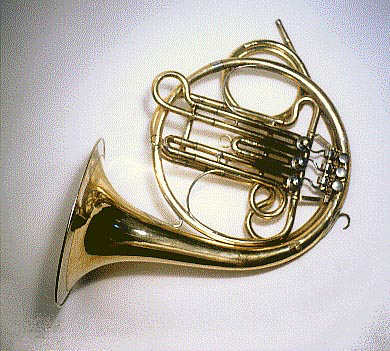
| Notice the unusual shape of the third valve slide.
Taking into account the loop at the base of the slide its
total length is approximately the same as the first valve
slide. On most three-valve brass instruments the third
valve is approximately one and one half times the length
of the first. It might seem at first that the first
and third slides have been swapped. This is not the
case since the distance between the legs of the third
valve slide is 5.0 mm larger than the first. They
can't be swapped since they don't fit each other.
The other expected possibility is that the third valve is
an full step ascending as invented by Jules Halary (ca.
1847) and commonly used in France. This is also not
the case, nor is there any evidence that the valve has
been reversed or modified in any way.
So it stands that the third valve is a DESCENDING full step but slightly longer than the first valve. The reason it is a little longer is to compensate for the sharpness that occurs when valves are used in combination. What this means to the player is that any notes normally played with valves 2 + 3 (e.g. written G#) must be played with 1 + 3. Similarly any notes normally played 1 + 3 are now 1 + 2 + 3 and low C# (normally 1 + 2 + 3) can only be played by hand stopping. This is a very unusual valve configuration, especially considering that the standard minor third descending valve dates from as early as 1819. |
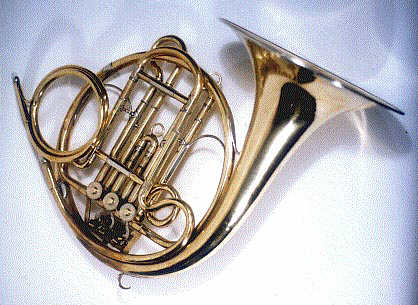 |
| Above, shown from the player's side with the F crook in place. Notice that the crook is somewhat higher that on most terminal crook horns. This puts the valves farther from the mouthpiece for an unusual holding angle. Note also the unusual large horizontal main tuning slide and large curved braces to the valve section. Compare these details with the Wilhelm Glujerin horn shown at the bottom of this page. |
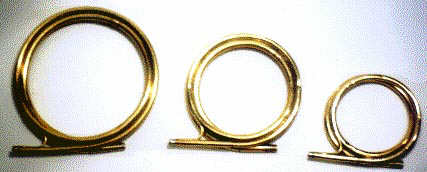 |
| A total of five terminal crooks accompany this horn. The above three are C, D, and F. The other two (which were being repaired at the time of the photo) are Eb and Ab |
| The rotary valves employ the encased coiled clockspring mechanism commonly found on European horns of the nineteenth and early twentieth centuries. Details of the workmanship on the valve cranks, and pinkie hook and bell brace might provide clues to the horn's origin. |
One informed source suggets that it was made in the vicinity of Prague perhaps in the latter nineteenth century. Another authority states that it is "more advanced than
the Polish horn, as the design is better balanced. Horns
of this kind with that many crooks were used mainly in
church orchestras in rural communities. The bore
is larger than the In Passau, Bavaria, Georg Heidegger made woodwind and brass instruments starting in 1840 and a horn of his design is in the Deutches Museum in Munich. He was also licensed as a stringed instrument maker and musical instrument dealer. Upon Heidegger's death in 1859 his partner, Johan Hornsteiner, married his widow, Antonia, and continued the business. The collection of musical instruments in Oberhausmuseum at Passau includes 45 wind instruments from Passau, the state of Bavaria, and Upper Austria. Among these are instruments from the Firma Heidegger, and Heidegger und Hornsteiner. Address: Oberhausmuseum der Stadt Passau, Georgsberg 125, D 94034 Passau. State, municipal and church museum. |
|
CimCim International Directory of Musical Instrument Collections |
)
)
)